


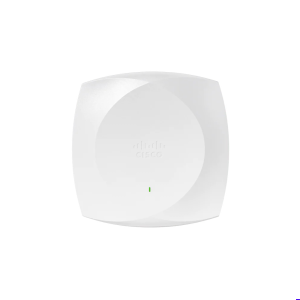
Cisco CW9178I-RTG Cisco Wireless 9178I(Wi-Fi 7, 4 radio, 3 band 4×4, UWB),Global
Table 2. Product specifications
|
Item |
Specification |
|||||||||
|
Part numbers |
Cisco Wireless 9178I Access Point: Internal antennas ● CW9178I
|
|||||||||
|
Software |
Cisco Wireless 9178I ● Cisco IOS ® XE Software Release 17.15.2 or later
|
|||||||||
|
Supported wireless LAN controllers |
● Catalyst 9800 Series Wireless Controllers (physical or virtual)
● Cisco Catalyst 9000 switches with Embedded Wireless Controller in SDA mode
|
|||||||||
|
802.11be |
● 4×4 + 4×4 uplink/downlink MU-MIMO with 4 spatial streams each (5 GHz)
● 4×4 uplink/downlink MU-MIMO with four spatial streams (2.4 and 6 GHz)
● 4096 QAM
● Multilink operation
● Preamble puncturing
● Uplink/downlink OFDMA
● TWT
● BSS coloring
● Maximal Ratio Combining (MRC)
● 20-, 40-, 80-, 160- and 320-MHz channels (6 GHz)
● 20-, 40-, 80-, and 160-MHz channels (5 GHz)
● 20-MHz channels (2.4 GHz)
● PHY data rates: in Quad radio mode, up to 24 Gbps (4×4 320 MHz on 6 GHz, 4×4 + 4×4 160 MHz on 5 GHz, and 4×4 20 MHz on 2.4 GHz); in Tri radio mode, up to 18 Gbps (4×4 320 MHz on 6 GHz, 4×4 160 MHz on 5 GHz, and 4×4 20 MHz on 2.4 GHz) or PHY data rates up to 23 Gbps (4×4 320 MHz on 6 GHz, 4×4 160 MHz on 5 GHz and 4×4 160 MHz on 5 GHz)
● Packet aggregation: Aggregate MAC Protocol Data Unit (A-MPDU) (transmit and receive), Aggregate MAC Service Data Unit (A-MSDU) (transmit and receive)
● 802.11 Dynamic Frequency Selection (DFS)
● Cyclic Shift Diversity (CSD) support
● Wi-Fi Protected Access 3 (WPA3) support
|
|||||||||
|
802.11ax |
● 4×4 + 4×4 uplink/downlink MU-MIMO with four spatial streams each (5 GHz)
● Uplink/downlink OFDMA
● 1024 QAM
● TWT
● BSS coloring
● MRC
● 802.11ax beamforming
● 20-, 40-, 80-, and 160-MHz channels (5 and 6 GHz)
● 20-MHz channels (2.4 GHz)
● PHY data rates up to 10.2 Gbps (4×4 160 MHz on 6 GHz, 4×4 + 4×4 80 MHz on 5 GHz, and 4×4 20 MHz on 2.4 GHz)
● Packet aggregation: A-MPDU (transmit and receive), A-MSDU (transmit and receive)
● 802.11 DFS
● CSD support
● WPA2/WPA3 support
|
|||||||||
|
802.11ac |
● 4×4 + 4×4 downlink MU-MIMO with 4×4 spatial streams
● MRC
● 802.11ac beamforming
● 20-, 40-, 80-, and 160-MHz channels
● PHY data rates up to 3.4 Gbps (dual 4×4 160 MHz on 5 GHz)
● Packet aggregation: A-MPDU (transmit and receive), A-MSDU (transmit and receive)
● 802.11 DFS
● CSD support
● WPA2/WPA3 support
|
|||||||||
|
802.11n version 2.0 (and related) capabilities |
● 4×4 MIMO with four spatial streams
● MRC
● 802.11n and 802.11a/g beamforming
● 20- and 40-MHz channels
● PHY data rates up to 1.5 Gbps (40 MHz with 5 GHz and 20 MHz with 2.4 GHz)
● Packet aggregation: A-MPDU (transmit and receive), A-MSDU (transmit and receive)
● 802.11 DFS
● CSD support
|
|||||||||
|
Integrated antenna |
● 2.4 GHz: Peak gain 4 dBi, internal antenna, omnidirectional in azimuth
● 5 GHz: Peak gain 5 dBi, internal antenna, omnidirectional in azimuth
● 6 GHz: Peak gain 6 dBi, internal antenna, omnidirectional in azimuth
● IoT: Peak gain 3 dBi, internal antenna, omnidirectional in azimuth
● UWB: Peak gain 7 dBi, internal antenna, omnidirectional in azimuth
● GNSS: (L1) Peak gain 5 dBi, (L5) Peak gain 2 dBi, internal antenna, omnidirectional in azimuth
|
|||||||||
|
Interfaces |
● 2x 100M/1000M/2.5G/5G/10G Multigigabit Ethernet (RJ-45)
● Management console port (RJ-45) with default speed of 115200 bps
● USB 2.0 at 9W
|
|||||||||
|
Indicators |
● Status LED indicates boot loader status, association status, operating status, boot loader warnings, and boot loader errors
|
|||||||||
|
Dimensions |
● Access point (without mounting brackets):
◦ 9.9 x 9.9 x 2.0 in. (25.1 x 25.1 x 5.1 cm) |
|||||||||
|
Weight |
4.1 lb. (1.87 kg) |
|||||||||
|
Input power requirements |
● 802.3bt Cisco Universal PoE (Cisco UPOE ®), 802.3at Power over Ethernet Plus (PoE+), 802.3af PoE (only for configuring staging, all radios off)
● (Or) Cisco Power Injector – CW-INJ-8
|
|||||||||
|
Power Source |
2.4-GHz radio |
5-GHz radio |
6-GHz radio |
Link speed |
USB |
Max PoE power consumption |
||||
|
802.3bt (Class 6) (UPOE) |
4×4 |
4×4(LB) + 4×4(HB) |
4×4 |
2x 10G |
Y (9W) |
47W |
||||
|
802.3at (PoE+) (Quad Radio mode) |
2×2 |
2×2 (LB) + 2×2 (HB) |
2×2 |
2x 2.5 G |
N |
25.5W |
||||
|
802.3at (POE+) (Tri Radio Mode) |
2×2 |
4×4 (FB) |
2×2 |
2x 1G |
N |
25.5W |
||||
|
802.3af (PoE) |
– |
– |
– |
1x 1G |
N |
13.95W |
||||
|
Note: Actual power consumption may vary depending on access point usage. It is recommended that you ensure that Link Layer Discovery Protocol (LLDP)/Cisco Discovery Protocol is enabled to allow proper power negotiation. Note: FB is Full Band, LB is Lower UNII Bands (UNII 1 and 2) and HB is Higher UNII Bands (UNII 2E and 3). Note: Above power draw table starting with IOS-XE version 17.15.3. |
||||||||||
|
Power Source |
Idle |
Typical |
||||||||
|
802.3bt (UPOE) |
20.7W ±2W |
25.7W ±4W |
||||||||
|
802.3at (PoE+) |
14.5W ±2W |
16.8W ±4W |
||||||||
|
Note: Actual power consumption may vary depending on AP usage. Typical power consumption assumes AP is passing traffic* during typical business hours, and is idle during off-business hours. Business hours are assumed to be 11 hours a day, 6 days a week. * Test Conditions: 802.3bt: The 6 GHz, 5 GHz high-band and 5 GHz low-band all operating at 160 MHz (4×4) passing 1 Gbps per band of download traffic and the 2.4 GHz band operating at 20 MHz (4×4) passing 150 Mbps of download traffic; USB disabled; 2x 10G Ethernet Ports; Ambient temperature 25˚C (77°F). 802.3at: The 6 GHz and the 5 GHz bands both operating at 160 MHz (2×2) passing 1 Gbps per band of download traffic and the 2.4 GHz band operating at 20 MHz (2×2) passing 150 Mbps of download traffic; USB disabled; 1x 10G Ethernet Port; Ambient temperature 25˚C (77°F). |
||||||||||
|
Environmental |
● Nonoperating (storage) temperature: -22° to 158°F (-30° to 70°C)
● Nonoperating (storage) altitude test: 25˚C (77°F) at 15,000 ft (4570 m)
● Operating temperature: 32° to 122°F (0° to 50°C)
● Operating humidity: 10% to 90% (noncondensing)
● Operating altitude test: 40˚C (104°F) at 9843 ft (3000 m)
Note: When the ambient operating temperature exceeds 40˚C (104˚F), the access point will shift from 4×4 to 2×2 on the 2.4-GHz, 5-GHz and 6-GHz radio(s); however, the USB interface will remain enabled. |
|||||||||
|
Available transmit power settings |
2.4 GHz ● 23 dBm (200 mW)
● -4 dBm (0.39 mW)
|
5 GHz ● 23 dBm (200 mW)
● -4 dBm (0.39 mW)
|
6 GHz ● 23 dBm (200 mW)
● -4 dBm (0.39 mW)
Note: In countries where use of the 6-GHz band is not allowed or there is no current software support, the 6-GHz radio will be disabled. The radio may be enabled with future software, once the product is certified to operate in 6 GHz for that country. |
|||||||
|
Compliance standards |
● Safety:
◦ IEC 60950-1 / IEC 62368-1 Ed.3 (with Ed.2 Deviation annex) ◦ EN 60950-1 / EN 62368-1 Ed.3 (with Ed.2 Deviation annex) ◦ UL 60950-1 / UL62368-1 3rd (with Ed.2 Deviation annex) ◦ CAN/CSA-C22.2 No. 60950-1 / CAN/CSA-C22.2 No. 62368-1 3rd (with Ed.2 Deviation annex) ◦ AS/NZS60950.1 / AS/NZS62368.1 Ed.3 (with Ed.2 Deviation annex) ◦ UL 2043 ◦ Class III equipment ● Emissions:
◦ CISPR 32 (rev. 2015) +AMD1:2019 ◦ EN 55032:2015/A11:2020 ◦ EN IEC 61000-3-2:2019/A1:2021 ◦ EN 61000-3-3:2013+A1:2019 ◦ AS/NZS CISPR32: 2015+AMD1:2020 ◦ 47 CFR FCC Part 15B ◦ ICES-003 (Issue 7, Class B) ◦ VCCI-CISPR 32:2016 ◦ CNS 13438:2006 (95) ◦ KS C 9832:2019 ◦ QCVN 118:2018/BTTTT ● Immunity:
◦ EN 55035:2017+A11:2020 ◦ KS C 9835:2019 ● Emissions and immunity:
◦ EN 301 489-1 V2.2.3 (2019-11) ◦ EN 301 489-17 V3.2.4 (2020-09) ◦ QCVN (18:2014) ◦ QCVN 112:2017/BTTTT ◦ KS X 3124:2020 ◦ KS X 3126:2020 ◦ EN 61000-6-1:2019 ◦ EN 60601-1-2:2015+A1:2021 |
● Radio:
◦ EN 300 328 (v2.2.2) ◦ EN 301 893 (v2.1.1) ◦ EN 303 687 (v0.0.14, draft) ◦ AS/NZS 4268 (rev. 2017) ◦ 47 CFR FCC Part 15C, 15.247, 15.407 ◦ RSP-100 ◦ RSS-GEN ◦ RSS-247 ◦ LP0002 (109) ◦ Japan Std. 66, and Std. 71 ● RF safety:
◦ EN 50385:2017 ◦ AS/NZS 2772 (rev. 2016) ◦ 47 CFR Part 2.1091 ◦ RSS-102 ● IEEE standards:
◦ IEEE 802.3 ◦ IEEE 802.3ab ◦ IEEE 802.3af/at ◦ IEEE 802.11a/b/g/n/ac/ax/be ◦ IEEE 802.11h, 802.11d ● Security:
◦ 802.11i (WPA2, WPA3) ◦ 802.1x/802.1x – SHA256 ◦ Enhanced Open/OWE ◦ Advanced Encryption Standard (AES) – GCMP128, GCMP256 and CCMP256 ● Extensible Authentication Protocol (EAP) types:
◦ EAP-Transport Layer Security (TLS) ◦ EAP-Tunneled TLS (TTLS) or Microsoft Challenge Handshake Authentication Protocol (MSCHAP) v2 ◦ Protected EAP (PEAP) v0 or EAP-MSCHAP v2 ◦ EAP-Flexible Authentication via Secure Tunneling (EAP-FAST) ◦ PEAP v1 or EAP-Generic Token Card (GTC) ◦ EAP-Subscriber Identity Module (SIM) |
||||||||
|
Certifications |
● Wi-Fi Alliance: Wi-Fi 7 (R1), Wi-Fi 6 (R2), Wi-Fi 6E, WPA3-R3, WPA3-Suite B, Enhanced Open Security
● Bluetooth SIG: Bluetooth Low Energy
|
|||||||||
Based on 0 reviews
Only logged in customers who have purchased this product may leave a review.




There are no reviews yet.